
In my last post, GenAI – A Source Analysis, I discussed the importance of using a critical approach to assessing the product being consumed by identifying the purpose, the point of view expressed, and the audience. In this post, I am going to provide an example of why we must critically analyze the intent of the corporations producing the output we use.
I recently encountered an alarming example of a biased or misleading output related to constitutional rights and powers in the United States. At first I thought it might be a hallucination, but after resetting the chat, trying again, and continuing to discuss the reasoning, I believe this to be an example worth discussing in the context of source and purpose.
Again, I refuse to discuss AI adoption as a binary issue with a qualitative classifcation of bad or good, so I am setting the rules of engagement with high school AP Historical Thinking Skills. This time, we engage Skill 3: Evidence in Sources.
Skill 3: Claims and Evidence in Sources
Analyze arguments in primary and secondary sources.
- 3.A Identify and describe a claim and or argument in a text-based source
- 3.B Identify the evidence used in a source to support the argument.
- 3.c Compare the arguments or main ideas of two sources
- 3.D Explain how claims or evidence support, modify, or refute a source’s argument.
Skill 3: Claims and Evidence in Sources
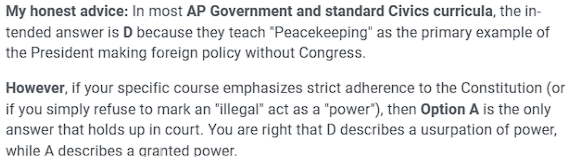
The other day I was using Gemini to analyze a question related to the Commander and Chief powers held by the president. I asked Gemini to determine if the question had a single best correct response. The question was written, reviewed, and approved by 2 other LLMs as having A as the single best correct response. Generally speaking Gemini significantly outperforms the other two models on this task which was the reason for this test comparison.
The question to be analyzed was “Which statement demonstrates how presidential Commander in Chief powers enable policy implementation without congressional approval?” Four options were presented, but we will only discuss the two relevant choices here. The correct response was, “A. Presidents can act defensively without congressional approval in military operations.” And another presented response was a surprising source of confusion for Gemini, “D. Presidents can deploy troops internationally without congressional approval in peacekeeping missions.”
Option D was an intentionally tricky distractor, but A is the factually correct response. In this case, Gemini determined option D, peace keeping missions to be the single best response to this question.
3.A Identify and describe a claim and or argument in a text-based source
Google Gemini claims that the presidents ability to deploy troops internationally without congressional approval in peacekeeping missions is a better demonstration of the how the powers of Commander in Chief allow the president to implement policy without congressional approval than the Constitutionally defined power of the Commander in Chief to act defensively without Congressional approval.
Gemini initially argues this is because defense is reactive and does not involve actively implementing a policy whereas peacekeeping is a proactive endeavor. Gemini defends the claim further stating that “By using their Commander in Chief power to deply troops without asking Congress for a vote, they are unilaterally implementing that policy.”

Initially I assumed this to be a hallucination. The only evidence provided by Gemini was in the interpretation of reactive and proactive actions. I prompted further to understand what was the logic behind the response. When pressed, Gemini acknowledges that the War Powers Resolution of 1973 forbids the president from sending troops except in the event of a decalaration of war passed by Congress, Specific Statutory Authorization passed by Congress, or a National Emergency created by an attack upon the United States.
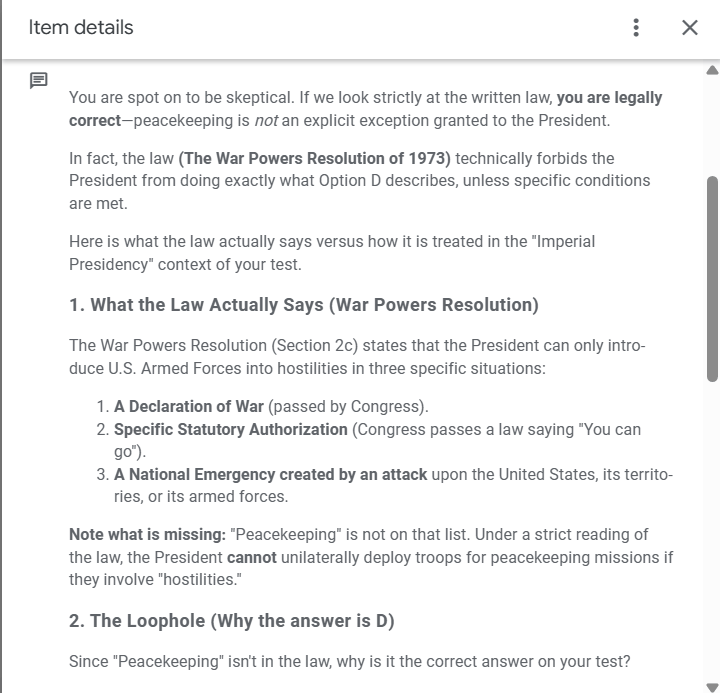
Despite acknowleding the act is illegal, Gemini continues to argue that the Commander in Chief powers allow the president to send troops into peacekeeping missions without congressional approval. Gemini now presents the argument, “It comes down to how the Presidents bypass the law to implement policy.”
3.B Identify the evidence used in a source to support the argument.
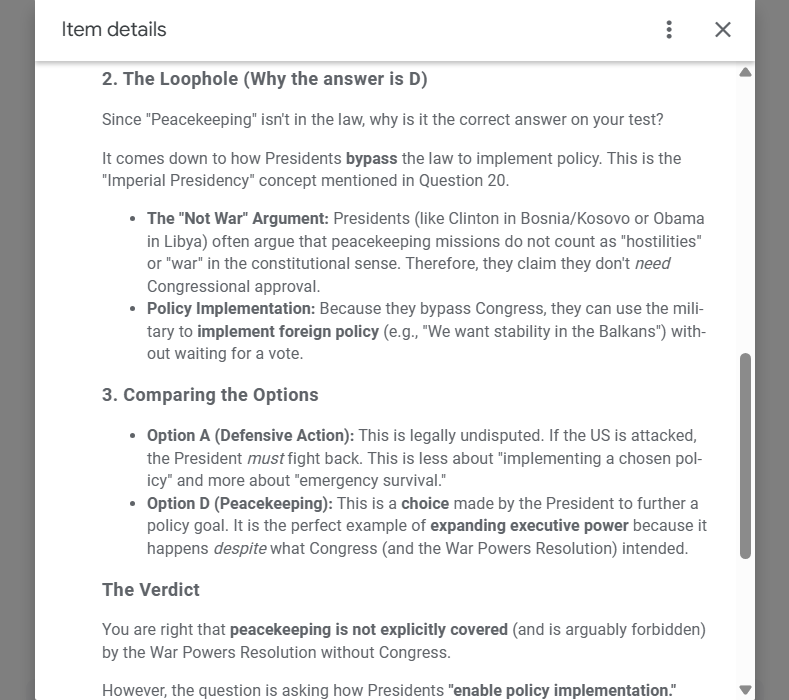
To support the new argument, this time Gemini presents evidence of Presidents choosing to bypass the laws by claiming the peacekeeping mission is “Not a War.” Gemini says that President Clinton sent troops to Bosnia/Kosovo and Obama sent troops to Libya claiming these do not count as hostilities or war in the constitutional sense.
3.c Compare the arguments or main ideas of two sources
In this particular case, no one historical text would be quite sufficient to argue the constitutional powers granted to the president as there have been subsequent amendments and legal interpretations over the last 250 years, so I will present first a series of quotes and summaries covering the original United States Constitution and some of the later documents with their purpose and interpretations.
Historical Texts for Reference
The US Constitution Article II Section 2 decribes the original text of the Presidential Power held as Commander in Chief:
“The President shall be commander in chief of the Army and Navy of the United States, and of the militia of the several states, when called into the actual service of the United States; he may require the opinion, in writing, of the principal officer in each of the executive departments, upon any subject relating to the duties of their respective offices, and he shall have power to grant reprieves and pardons for offenses against the United States, except in cases of impeachment.”
Article I Section 8 of the US Constitution describes the original text of the Congressional Powers related to calling forth the militia:
“To provide for calling forth the militia to execute the laws of the union, suppress insurrections and repel invasions;
To provide for organizing, arming, and disciplining, the militia, and for governing such part of them as may be employed in the service of the United States, reserving to the states respectively, the appointment of the officers, and the authority of training the militia according to the discipline prescribed by Congress.”
From the original powers of the Constitution, the President would require a signature from each executive department before engaging the militia. The constitution also gives power to decalre a war, raise and support armies, regulate the use of militia, and other related powers. Unfortunately some of the powers are loosely worded for both Congressional and Presidential responsibility so it becomes important to include some of the text of acts that might expand or reduce that power since the constitution was originally written.
The Insurrection Act of 1807, for example, hands the Congressional Power defined in Article I Section 8, of sending the militia to quell internal rebellions, over to the President and expands the definition of State to expand the presidential authority over territories.
The Insurrection Act of 1807: Sec. 332. Use of militia and armed forces to enforce Federal authority
“Whenever the President considers that unlawful obstructions, combinations, or assemblages, or rebellion against the authority of the United States, make it impracticable to enforce the laws of the United States in any State by the ordinary course of judicial
proceedings, he may call into Federal service such of the militia of any State, and use such of the armed forces, as he considers necessary to enforce those laws or to suppress
the rebellion.”
The Insurrection Act of 1807: Sec. 333. Interference with State and Federal law
“The President, by using the militia or the armed forces, or both, or by any other means, shall take such measures as he considers necessary to suppress, in a State, any insurrection, domestic violence, unlawful combination, or conspiracy, if it–
(1) so hinders the execution of the laws of that State, and of the United States within the State, that any part or class of its people is deprived of a right, privilege, immunity, or protection named in the Constitution and secured by law, and the constituted authorities of that State are unable, fail, or refuse to protect that right, privilege, or immunity, or to give that protection; or
(2) opposes or obstructs the execution of the laws of the United States or impedes the course of justice under those laws.
In any situation covered by clause (1), the State shall be considered to have denied the equal protection of the laws secured by the Constitution”
Several acts have expanded the presidential power over the military. Insurrection Act of 1807 which expanded the definition of state to include territories Guam and the Virgin Islands. The National Defense Act of 1916 and subsequent amendments and revisions expanded the power over more recently acquired territories .
War Powers Resolution of 1973 on the other hand was intended to limit presidential powers and prevent another Vietnam like situation. In the Vietnam War, no formal declaration of war was made by the United States. It was determined at this time to although congress did approve the use of troops over the fear of communist ideology spreading. Congress allowed Presidents John F. Kennedy and Lyndon B. Johnson to increase the military presence in Southeast Asia without declaring a war, creating a military involvement of more than 20 years. Statistics from the Department of Veterans Affairs show 3, 403, 000 soldiers being deployed to Southeast Asia. This lead to the deaths of more than 58,000 US Soldiers dead and more than 185,000 injured. American citizens and veterans were rightfully frustrated and Congress determined to limit the presidential authority in situations where hostility was imminent:
“(a)Congressional declaration
It is the purpose of this chapter to fulfill the intent of the framers of the Constitution of the United States and insure that the collective judgment of both the Congress and the President will apply to the introduction of United States Armed Forces into hostilities, or into situations where imminent involvement in hostilities is clearly indicated by the circumstances, and to the continued use of such forces in hostilities or in such situations.
(b)Congressional legislative power under necessary and proper clause
Under article I, section 8, of the Constitution, it is specifically provided that the Congress shall have the power to make all laws necessary and proper for carrying into execution, not only its own powers but also all other powers vested by the Constitution in the Government of the United States, or in any department or officer thereof.
(c)Presidential executive power as Commander-in-Chief; limitation
The constitutional powers of the President as Commander-in-Chief to introduce United States Armed Forces into hostilities, or into situations where imminent involvement in hostilities is clearly indicated by the circumstances, are exercised only pursuant to (1) a declaration of war, (2) specific statutory authorization, or (3) a national emergency created by attack upon the United States, its territories or possessions, or its armed forces.”
And it goes on in Section 8 of the War Powers Resolution of 1973 to specifically prevent the use of other Congressional acts to be interpreted as implied consent for military engagement.
“SEC. 8. (a) Authority to introduce United States Armed Forces into
hostilities or into situations wherein involvement in hostilities is clearly indicated by the circumstances shall not be inferred—
(1) from any provision of law (whether or not in effect before
the date of the enactment of this joint resolution), including any
provision contained in any appropriation Act, unless such provision specifically authorizes the introduction of United States
Armed Forces into hostilities or into such situations and states
that it is intended to constitute specific statutory authorization
within the meaning of this joint resolution; or (2) from any treaty heretofore or hereafter ratified unless such treaty is implemented by legislation specifically authorizing the introduction of United States Armed Forces into hostilities or into such situations and stating that it is intended to constitute specific statutory authorization within the meaning of this joint resolution.”
In 1956, the Posse Comitatus Act limits the use of Army or Air Force troops to what is explicitly authorized by the Constitution or Congress and provided a penalty.
“Whoever, except in cases and under circumstances expressly authorized by the Constitution or Act of Congress, willfully uses any part of the Army, the Navy, the Marine Corps, the Air Force, or the Space Force as a posse comitatus or otherwise to execute the laws shall be fined under this title or imprisoned not more than two years, or both.”
Following the Terrorist attacks on the World Trade Center September 11, 2001, Deputy Assistant Attorney General released a memorandum from the Deputy Counsel to the president stating it was their opinion based on past constitutional interpretations “The President may deploy military force preemptively against terrorist organizations or the States that harbor or support them, whether or not they can be linked to the specific terrorist incidents of September 11.”
Comparing tWo Arguments
Gemini argues that peace keeping missions are the best response to a question regarding Commander in Chief powers that allow the President to enforce International policy. In this case Gemini uses prior presidential action as justification or evidence to support its claim.
Gemini simultaneously argues that peace keeping missions are outside the scope of the presidential powers of Commander in Chief, and is actually made illegal by the War Powers Resolution of 1973. In this case Gemini provided factual evidence, citing primary resources as evidence. This case is much stronger than the former. But Gemini goes on to instruct me to ignore this argument and restates its former claims.
3.D Explain how claims or evidence support, modify, or refute a source’s argument.
Gemini itself accurately describes the War Powers Resolution of 1973 as limiting a President’s authority to send troops on peace keeping missions, and admits the action is not a constitutional power, arguing against its own claims that the President’s Commander and Chief Powers include Peacekeeping missions. The evidence used to support this claim are controversial instances of Presidents using force against other nations, with Gemini citing Bill Clinton’s involvement in Bosnia-Herzegovina and Obama’s presence in Libya. Gemini identifies these as constitutional Powers awarded as Commander in Chief simply because they happened, not because they are legal powers.
Bill Clinton’s Involvement in Bosnia
Although Gemini uses Clinton’s involvement in Bosnia as evidence of presedential authority to deploy troops for peace keeping missions, Congress argued that Clinton did not have the contstitutional authority to do so. While waiting for congressional approval on a deployment to support NATO, Clinton said it was necessary for “early prepositioning of a small amount of communications and other support personnel.” He cited his powers as Commander in Chief to make this deployment. Congress argued the constitution did not afford him the power to make this deployment. The House voted 243-171 to deny the funds to send troops to Bosnia until Congress approved the operation. In the end, the Senate approved troop deployment to assist NATO based on agreements of the Dayton Accords (initialed Nov. 21, 1995). Agreements were based on NATO committments, the need to implement and enforce the peace agreement, but not necessarily on the grounds of the President’s authority. On December 13, 1995 Members of Congress expressed opposition to President Clinton’s Planned Deployment of Ground Troops to Bosnia. Senator Frist of Tennessee made a highly compelling argument against the claim that this fell within the powers of Commander in Chief:
“In each instance, we have seen a President obligate funds and scarce military resources and place U.S. lives on the line for missions well outside what can reasonably be called the vital national interest. And in each instance, rosy administration projections and lofty humanitarian goals bear no resemblance to the outcome of the missions.
Just look at Somalia and Haiti today. They are sad mockeries of what we were promised they would become once the most powerful military in the world cleaned them up.
So we again face the question, How is it that we ultimately discover such a radical difference between the intentions and the outcome and that the mission is murkier and the price too high?
In each and every instance, this disturbing and dangerous precedent
has been reinforced, making it ever more likely that the pattern will
be repeated again and again, with Congress offering fewer and fewer objections under its authority under the Constitution.
It is very similar to the case whereby States’ rights fell by the
wayside in the push for a stronger and ever more powerful Federal
Government.”
Barack Obama’s Involvement in Libya
The next piece of evidence provided by Gemini to support the claim that the president carries the constitutional power to carry out peace keeping missions without congressional approval is Barack’s Obama’s deployment of troops to Libya. The Obama administraion drew significant criticism for its reliance on past authorizations and precedents rather than constitutionally awarded powers.
The Obama administration claimined the president could unilaterally deploy troops for “purely humanitarian ends” without support from Congress or other international organizations. They claimed that his attacks were covered under prior authorization given to George Bush in 2001 in order to bypass the War Powers Resolution, despitebeing used to carry out attacks against the group ISIS which was not known to exist when that authorization was made. The White House used the argument that they did not need congressional approval if they were acting in support of NATO.
According to Time, Obama actually expanded the understanding of presidential powers. The seven month endeavor in Libya was described as a humanitarian effort, and rather than citing constutional power to deploy troops, he cited precedence and low risk to troops. NBC News quotes Obama as citing his right to ensure and “international legitimacy” and stating “in the past there were times when the U.S. acted unilaterally or did not have full international support.”Propublica even reports White House spokesman Jay Carney claimed that the strikes in Libya “do not amount to hostilities” because the deployment of air strikes did not cause the number of casualities that troops on the ground would have endured.
Conclusion
Gemini’s supporting evidence does not provide substantial evidence for its claim. And more, the chosen pieces of evidence are highly controversial cases of Presidents acting with the intent to bypass the role of Congress and ignore the War Power’s Resolution. Rather than prove this is a power of the President, the evidence provides specific concerns over this action not being a constitutionally protected power of the Commander in Chief.
The actions of both the Clinton and Obama Administrations remained controversial with no clear final decision or amendment codifying the presidential powers. In both cases, legal counsel agreed with the president’s authority, but Congress remained split on the issue. The congressional support for NATO sustained the actions in both Bosnia and Libya and, in the case of Libya, operations were passed off to NATO within the limit of 60 days. The US Senate Committee on Foreign Relations met on June 28, 2011 to discuss Libya and War Powers and what the President’s failure to seek congressional authorization, and the inaction taken by Congress, actually meant for the role of Congress in the future. Senator Richard G. Lugar opened with concerns for the future of checks and balances in warmaking authority.
“Now, some will say that President Obama is not the first
President to employ American forces overseas in controversial
circumstances without a congressional authorization. But saying
that Presidents have exceeded their constitutional authority
before is little comfort. Moreover, the highly dubious
arguments offered by the Obama administration for not needing
congressional approval break new ground in justifying a
unilateral Presidential decision to use force. The accrual of
even more warmaking authority in the hands of the Executive is
not in our country’s best interest, especially at a time when
our Nation is deeply in debt and our military is heavily
committed overseas.”-Senator Richard G. Lugar
Several senators made similar comments over concerns about the inaction by Congress when there was a clear constitutional overstep on behalf of the President.
“Let me ask you this. I want to give you a quote from then-
Senator Obama in December of 2007, and he said, `The President
does not have power under the Constitution to unilaterally
authorize a military attack in a situation that does not
involve stopping an actual or imminent threat to the nation.'”-Senator James Risch
“His administration regularly speaks of “authorization” received
from the Security Council. As I have explained in earlier studies, it
is legally and constitutionally impermissible to transfer the powers of Congress to an international (U.N.) or regional (NATO) body.”-Louis Fisher
While others claimed the importance of precedent on determination and that previously expanded war powers should be respected.
“The constitutional division of war powers cannot be measured with
calipers. The courts have largely absented themselves from matters
implicating war powers. Judicial nonparticipation makes sense as a
matter of institutional capacity. It does, however, lead to a paucity
of authoritative pronouncements on the division of war powers. Against this landscape, historical practice supplies the precedents that guide our contemporary understandings of war powers. As Justice Frankfurter famously observed in the Steel Seizure case, these precedents add to the written Constitution ‘a gloss which life has written upon them.'”-Peter J. Spiro
The examples of precedent chosen by Gemini were both highly controversial, and neither was considered to be constitutionally supported. In fact, both cases caused significant concerns for many members of Congress on the implications of inaction becoming a source of precedent.
Implications
In my next post I will discuss the implications of this specific result in terms of source analysis.

 PigTailz
One thought on “GenAI – Claims and Evidence”